LLC vs C-Corp vs Sole Proprietorship: What Should a Non-Resident Choose?
Compare an LLC, a C-Corporation and a sole proprietorship for non-resident founders: liability, U.S. tax forms, investors and yearly paperwork.
 Muhammad Abuzar Updated November 2026 7 min read
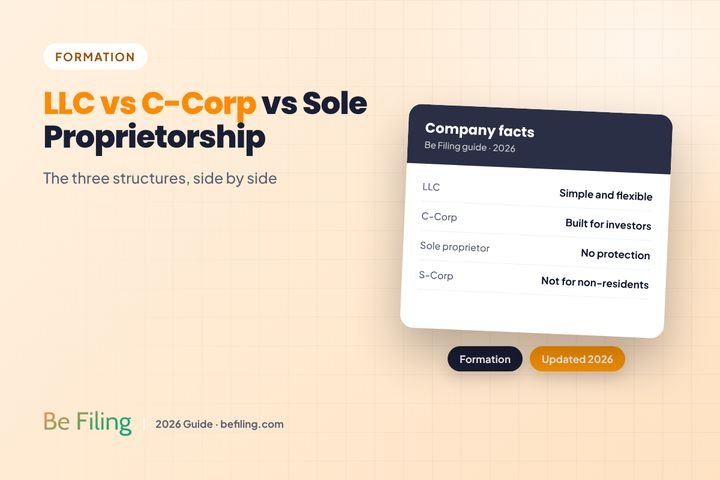
Which business structure is best for a non-resident?
Most non-resident founders choose an LLC because it protects personal assets, is simple to run and passes profit through to the owner. A C-Corporation is the right choice when you plan to raise venture capital or issue shares to employees. A sole proprietorship gives no liability protection and is rarely accepted by U.S. payment platforms for foreign owners.
1The three structures compared
| Point | LLC | C-Corporation | Sole proprietorship |
|---|---|---|---|
| Separate legal entity | Yes | Yes | No |
| Personal liability protection | Yes | Yes | No |
| Federal income tax | Passes through to the owners | 21% flat corporate rate | Taxed on the owner |
| Typical yearly federal form | Form 5472 with pro forma 1120, or Form 1065 | Form 1120 | Form 1040-NR when U.S. tax applies |
| Raising venture capital | Difficult | Standard | Not possible |
| Paperwork | Low | Higher | Lowest |
2Why most non-residents pick an LLC
An LLC separates your personal assets from the business, has few formalities and lets you choose how the company is managed. A single-member LLC owned by a foreign person is a disregarded entity for federal tax, so the company itself does not pay corporate income tax.
It must still file Form 5472 with a pro forma Form 1120 every year, even when it has no income.
3When a C-Corporation makes sense
- You plan to raise money from venture capital funds or angel investors.
- You want to give shares or stock options to co-founders and employees.
- You expect to keep profit inside the company and reinvest it.
A C-Corporation pays a 21% federal tax on its profit. Dividends paid to a foreign shareholder are generally subject to 30% U.S. withholding, or a lower rate when a tax treaty applies.
4Why not an S-Corporation or a sole proprietorship
An S-Corporation cannot have a non-resident alien as a shareholder, so it is not available to most foreign founders.
A sole proprietorship is not a separate company. You are personally responsible for every debt and claim, and most marketplaces and payment platforms ask foreign sellers for a registered U.S. entity with an EIN.
5Can you change later?
Yes. Many founders start with an LLC and convert to a C-Corporation when investors ask for it. Both structures use the same Be Filing formation plans.
Official sources
- U.S. Small Business Administration: Choose a business structure
- IRS: Limited liability company (LLC)
- IRS: About Form 5472
Be Filing Inc is a Certifying Acceptance Agent. This guide is general information, not legal or tax advice, and rules can change. Last reviewed in November 2026.
Quick questions, answered
Short, direct answers. If yours is not here, NIA or our team will help.
Ask on WhatsAppCan a non-resident own 100% of a U.S. LLC?
Yes. There is no citizenship or residency requirement to own a U.S. LLC or C-Corporation.
Does an LLC pay U.S. corporate tax?
Not by default. An LLC is taxed on its owners unless it elects to be taxed as a corporation.
Can a non-resident form an S-Corporation?
No. S-Corporation shareholders must be U.S. citizens or U.S. tax residents.
Which structure do investors prefer?
Venture capital investors almost always ask for a Delaware C-Corporation.
Related guides
Ready to form your U.S. company?
Pick your state and plan. Plans start at $99 plus the state fee, and every step is tracked in your portal.